
Discover the most-read stories and insights from our community
IntroductionDoes your team still rely on WhatsApp messages, last-minute calls, or Excel sheets to manage spare parts purchases? If so, you’re not alone — but you’re also at risk of stockouts, overstocking, inflated costs, and production delays.It’s time to move from chaos to control with a structured spare parts procurement plan tailored for industrial operations.In this step-by-step guide, we’ll show you how to build a smart, streamlined procurement process — and how the HUB Industrial Procurement Ecosystem supports every step.🧭 Step 1: Audit Your Existing Spare Parts InventoryWhy it matters: You can’t manage what you can’t see.Action: List all spare parts in use, including frequency of use, lead times, current stock levels, and criticality.HUB Solution: HUB allows you to upload and track your inventory data for better visibility and forecasting.🛠️ Step 2: Categorize Spare Parts by Criticality & UsageWhy it matters: Not all parts are equal — a control relay and a PLC CPU don’t carry the same risk if unavailable.Action: Use ABC or VED (Vital–Essential–Desirable) analysis to rank parts.HUB Solution: HUB helps tag parts and assign levels to facilitate smarter reorder logic and budget planning.📅 Step 3: Create a Procurement ScheduleWhy it matters: Scheduling parts procurement around maintenance and consumption patterns prevents chaos.Action: Align purchases with planned downtime, seasonal demand, and lead times.HUB Solution: HUB’s scheduling feature allows you to automate procurement cycles and set alerts.📋 Step 4: Establish a Multi-Level Approval WorkflowWhy it matters: Without structure, engineers buy unapproved or overpriced parts.Action: Define roles: Engineers (request), Managers (review), Procurement (budget), Finance (approve).HUB Solution: HUB enables a tiered workflow for requests, reviews, and approvals — fully trackable.🧾 Step 5: Choose Verified Suppliers with Historical DataWhy it matters: Working with unreliable vendors leads to delays and quality issues.Action: Build a database of trusted vendors with historical performance indicators.HUB Solution: HUB hosts multi-vendor listings with ratings, price comparisons, and availability filters.📊 Step 6: Monitor, Analyze, and ImproveWhy it matters: The best plans are dynamic. Review what's working and adjust.Action: Use KPIs like lead time, stock turnover, emergency purchase ratio, and part consumption trends.HUB Solution: HUB provides AI-powered analytics dashboards to guide continuous improvement.✅ ConclusionA structured procurement plan is no longer a luxury — it’s a necessity for industrial performance. By organizing inventory, scheduling smarter purchases, involving the right people, and analyzing data, your spare parts strategy becomes a source of competitive advantage.HUB brings all of this together in one platform — from planning and approvals to supplier matching and analytics.🔗 Start planning with HUB : www.HUBSpareparts.com🔗 Schedule a free consultation: WhatsApp chat
IntroductionHaving too many spare parts might seem safe, but it’s a silent profit killer. Overstocking ties up capital, increases storage costs, and often leads to waste through obsolescence or damage. Many factories overcompensate to “be safe,” without realizing the hidden financial and operational costs.In this post, we unpack the real cost of overstocking and show how HUB’s smart inventory tools keep your spare parts levels optimized.💸 The Hidden Financial Costs of Overstocking - Capital Lock-In: Spare parts represent frozen cash that could be used elsewhere. - Higher Insurance & Taxes: Excess stock increases warehousing expenses and insurance premiums. - Depreciation & Obsolescence: Parts become outdated or unusable over time, especially in fast-evolving industries. - Waste from Damage or Expiry: Some items have shelf lives (e.g., lubricants, seals) and degrade when left unused.🏭 The Operational Downsides - Crowded Warehouses: Overstocking clutters space, making retrieval slower and harder. - Inventory Errors: Larger stockpiles lead to higher chances of miscounts, lost items, or duplicate orders. - Blocked Workflow: Unnecessary items consume resources like labor and storage that should focus on critical parts.🧠 How HUB Helps You Avoid Overstocking 📊 1. Data-Driven Demand Forecasting - HUB analyzes historical consumption trends to recommend optimal stock levels based on actual usage — not guesswork. 🛠️ 2. Dynamic Reorder Points - Rather than fixed formulas, HUB adjusts reorder points automatically as usage, lead times, or failure patterns evolve. 🚦 3. Slow-Moving Parts Alerts - HUB flags stagnant or slow-moving items, giving you a chance to repurpose, resell, or stop reordering. 📈 4. Real-Time Inventory Dashboards - Gain full visibility into stock levels by location, category, and criticality — ensuring you see and act on overstock trends. 🔄 5. Resale & Exchange System - Turn stagnant stock into cash or trade through HUB’s marketplace feature — freeing up capital and space.✅ ConclusionMore isn’t always better. Overstocking might feel safe, but it creates hidden costs that drain your budget and slow down your operations. With HUB, you can strike the perfect balance between availability and efficiency — keeping your inventory lean, optimized, and productive.🔗 [Try HUB’s Inventory Optimization Tools]🔗 [Book a Free Inventory Audit Demo]
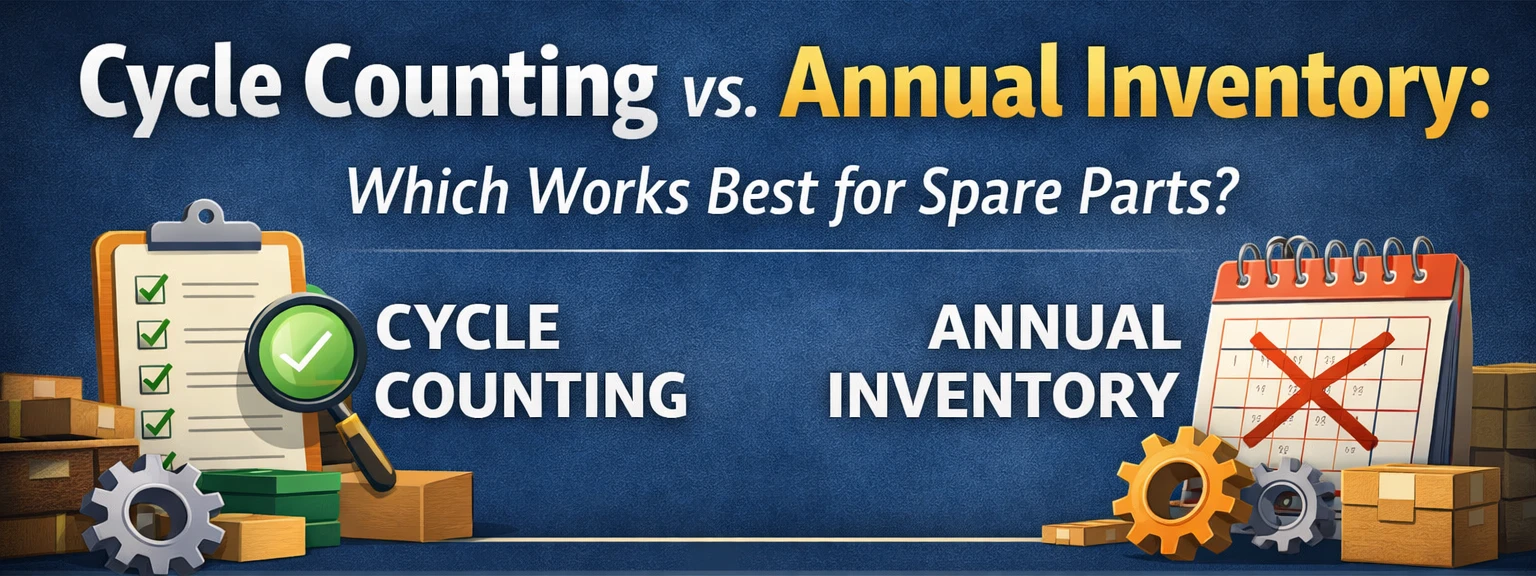
IntroductionInventory accuracy is critical for reliable spare parts procurement. But how should you track it? Many companies rely on annual inventory audits, while others use cycle counting for ongoing accuracy. Each method has strengths and weaknesses — especially in the world of industrial spare parts, where stock turnover and criticality vary widely.In this post, we compare both methods and explain how HUB’s tracking tools support smarter, more reliable inventory management.📅 What Is Annual Inventory?An annual inventory audit counts all stock items once per year — usually during a planned shutdown.✅ Pros:- Comprehensive "snapshot"- Useful for audits and compliance- Easy to schedule once annually❌ Cons:- Requires halting operations- Prone to large errors if stock drifts between counts- Time-consuming and resource-heavy🔄 What Is Cycle Counting?Cycle counting involves regularly counting small sections of inventory (e.g., weekly or monthly) rather than everything at once.✅ Pros:- Less disruption to operations- More consistent accuracy- Errors are caught and corrected faster❌ Cons:- Requires ongoing resources- May miss slow-moving items if not well-planned- Complexity increases with large inventories🧠 Which Works Best for Spare Parts?For high-value or fast-moving spare parts, cycle counting is typically superior because it ensures ongoing accuracy. However, annual inventory can be a good backup for full validation — especially for compliance or external audits.🚀 How HUB Enhances Both Methods ✅ 1. Automated Cycle Count Scheduling - HUB lets you schedule counts by part type, usage rate, or location — ensuring critical spares are checked more often. 📊 2. Real-Time Inventory Dashboards - Track discrepancies instantly with live dashboards that highlight mismatches between expected and actual stock. 🔔 3. Alerts for Slow-Moving or High-Risk Items - Prioritize cycle counts on items prone to errors, spoilage, or theft. 📤 4. Easy Data Export & Audit Reports - Generate reports instantly for external auditors or compliance checks.✅ ConclusionBoth cycle counting and annual inventory have roles to play — but for critical spare parts, ongoing cycle counts combined with HUB’s smart tracking tools give you the accuracy, flexibility, and confidence you need.🔗 Start Smart Counting with HUB: www.HUBspareparts.com🔗 Book a Demo of HUB’s Inventory Tools: WhatsApp Chat
IntroductionEvery maintenance manager faces a balancing act: order too many spare parts and risk tying up capital, or keep too few and risk a shutdown when something fails. These two extremes are embodied by two popular inventory philosophies: Just-in-Time (JIT) and Just-in-Case (JIC).So, which strategy is right for your plant — and how can you implement the right one intelligently?In this post, we’ll break down the pros and cons of each approach and explain how the HUB Industrial Procurement Ecosystem helps factories optimize their spare parts strategy through smart scheduling, analytics, and planning.🔁 What Is Just-in-Time (JIT) Procurement?JIT means keeping the bare minimum stock on hand and ordering parts exactly when needed — based on production schedules, equipment condition, or predictive analytics.✅ Benefits: - Lower inventory holding costs - Less warehouse space required - Reduced waste from obsolete parts❌ Risks: - Delays if suppliers are slow - High dependency on accurate forecasts - Supply chain disruptions can halt production📦 What Is Just-in-Case (JIC) Procurement?JIC means stocking parts “just in case” something fails. It's a buffer-heavy approach favored in unstable supply chains or high-risk environments.✅ Benefits: - Immediate availability of critical parts - Less downtime during emergencies - Greater flexibility❌ Risks: - Capital locked in unused inventory - Potential for obsolete stock buildup - Harder to manage for large SKUs🧠 How HUB Helps You Implement Smart JIT (or Hybrid) Strategies📊 1. Predictive Procurement with Data AnalyticsHUB uses your historical consumption, failure patterns, and machine data to forecast when specific parts will be needed — making JIT safer and smarter.📅 2. Spare Parts SchedulingSet automated reorder timelines based on planned maintenance windows and average usage cycles. HUB’s scheduling tool ensures parts arrive just before you need them — not after.📦 3. Critical Parts Classification & AlertsTag essential JIC components (like PLC CPUs or high-failure items) to remain stocked, while low-risk items are ordered JIT. HUB enables hybrid strategies — not one-size-fits-all.📈 4. Real-Time Inventory Visibility & Vendor IntegrationSee stock levels across departments and get real-time pricing and lead times from HUB’s vendor network — making JIT purchasing reliable.🔄 When to Use JIT vs. JIC (Decision Matrix)ScenarioRecommended StrategyLong supplier lead timesJust-in-Case (JIC)Stable supply chainsJust-in-Time (JIT)Budget or space constraintsJust-in-Time (JIT)Remote or critical operationsJust-in-Case (JIC)Data-rich, connected systemsJIT (with HUB)Limited analytics or visibilityJIC or hyprid✅ ConclusionBoth JIT and JIC have their place. The smartest strategy? Use data to guide when to apply each, and tools like HUB to execute your procurement strategy effectively.With HUB, your factory doesn’t have to choose between cost control and availability — you get both.🔗 Start optimizing your strategy with HUB : www.HUBspareparts.com🔗 Book a free consultation with HUB advisors : WhatsApp Chat
IntroductionA factory can’t afford to stop because a $20 sensor wasn’t available in time. Yet, this happens every day due to poor spare parts reorder strategies. If you’ve ever dealt with stockouts, emergency purchases, or overfilled stores, the problem isn’t what you’re ordering — it’s how and when you reorder.In this post, we’ll show you how to build a reorder strategy that’s practical, cost-effective, and built around real-world consumption data. We’ll also show how HUB’s planning tools make it easy.🔄 Step 1: Identify Critical vs. Non-Critical Spare PartsNot all parts need the same attention. - Critical: Can stop production (e.g., PLC CPUs, main contactors) - Non-Critical: Delay but don’t halt operation (e.g., indicator lamps)With HUB: Tag parts by priority and set dynamic reorder rules per category.📊 Step 2: Track Consumption Patterns and Usage RatesDetermine how often parts are consumed — monthly, seasonally, or based on asset runtime.Example:If you use 8 pressure sensors every quarter, that’s ~2.7/month average usage.With HUB: Upload past purchase and usage data to auto-calculate consumption trends across locations and departments.📅 Step 3: Define Accurate Lead TimesKnow how long it takes from ordering to delivery for each item — including supplier processing, shipping, and customs clearance (if needed).Pro Tip: Always add a safety buffer.With HUB: Supplier lead times are visible and updated across vendor profiles. HUB can also flag long lead items for advance reordering.📦 Step 4: Set Intelligent Reorder Points (ROP)The Reorder Point = (Average Daily Usage × Lead Time in Days) + Safety StockIf you use 2 relays/day and lead time is 7 days, you need 14 pcs + 20% buffer = ~17 pcs reorder point.With HUB: Automate ROP calculations and get alerts when items hit reorder level — no manual spreadsheets.🧠 Step 5: Use Predictive Reordering for Frequently Used ItemsFor frequently used SKUs, you can automate replenishment using predictive models.With HUB: The system identifies recurring usage patterns and can suggest auto-reorder schedules by item, location, or team.🧾 Step 6: Review, Adjust, and Optimize MonthlyReorder strategies must adapt to: - Changes in suppliers - Maintenance cycles - Budget constraintsWith HUB: Dashboards show what’s working, what’s overstocked, and what’s overdue — in real time.✅ ConclusionReorder planning is not just about quantity — it’s about timing, logic, and data. With HUB, your team can build a reorder strategy that eliminates guesswork, avoids emergency costs, and keeps production flowing.🔗 Try HUB’s Reorder Planning Tools: www.HUBspareparts.com🔗 Book a demo and optimize your inventory: WhatsApp Chat
IntroductionYou’ve secured the best price for a spare part — but if it arrives late, the hidden costs can quickly outweigh the savings. Supplier lead time is often overlooked, yet it’s a key driver of downtime, emergency orders, and inflated costs.In this post, we unpack the hidden financial impact of supplier delays and show how HUB’s supplier tracking tools help you choose the best vendors for both price and performance.💸 The Hidden Costs of Supplier Delays 1️⃣ Production Downtime - Every hour of delay can cost thousands in lost productivity, missed deadlines, and overtime charges. 2️⃣ Emergency Orders & Rush Fees - When parts arrive late, companies often scramble to source replacements at premium rates. 3️⃣ Inventory Buffering - To hedge against unreliable suppliers, you may keep excess stock — tying up capital and storage space. 4️⃣ Damaged Supplier Relationships - Frequent delays can erode trust and hurt long-term collaboration, making procurement less efficient.🛠️ How HUB Tracks and Ranks Supplier Performance 📊 1. Lead Time Analytics - HUB records actual delivery times vs. promised timelines for each supplier, providing a real-time reliability score. 🔔 2. Delay Alerts - Get notified instantly if a supplier’s performance slips — so you can act before problems escalate. 📈 3. Vendor Ranking Dashboards - Rank suppliers by lead time, accuracy, quality, and cost to make balanced procurement decisions. 📄 4. Historical Performance Reports - Review long-term trends and spot recurring issues before placing large or critical orders.💡 Pro Tip - Use HUB’s supplier analytics during vendor negotiations to secure better lead time guarantees and enforce accountability.✅ Conclusion - Lead time isn’t just a metric — it’s a major cost driver. With HUB’s supplier tracking tools, you can minimize delays, cut hidden costs, and choose vendors who deliver both value and reliability.🔗 Discover HUB’s Supplier Performance Tools: www.HUBspareparts.com🔗 Book a Demo of HUB’s Analytics Dashboard: Connect Us


You need to Sign in to view this feature

This address will be removed from this list
 english