
Learn how digital procurement ecosystems like HUB help engineers optimize spare parts planning, reduce downtime, and improve supply chain efficiency.

IntroductionIn today’s fast-moving industrial environment, traditional spare parts procurement can no longer keep up with production demands. Delays, overstocking, and unplanned downtime cost industries millions annually. The solution? AI-powered predictive procurement – and at the forefront of this revolution is HUB Industrial Spare Parts Procurement Ecosystem.The Problem with Traditional ProcurementConventional spare parts sourcing is reactive. Orders are made after a failure occurs or just in case inventories run low. This approach results in:✔️ Unused stagnant inventory✔️ Emergency orders at premium prices✔️ Risk of production stoppages due to part shortagesHow HUB Solves It with AI + Data AnalyticsHUB transforms spare parts procurement by turning data into actionable foresight. Here’s how:🧠 Predictive Procurement EngineBy analyzing consumption history, asset criticality, and downtime trends, HUB forecasts when and what spare parts are needed – long before failure occurs.📅 Procurement Scheduling & Workflow ManagementHUB enables engineers to schedule recurring or expected part purchases and route them through a structured multi-tier approval process involving engineering, purchasing, and executive layers.📊 Data-Driven Insights for Smart Decision MakingReal-time dashboards show usage patterns, supplier performance, regional trends, and cost-saving opportunities. This empowers managers to:✔️ Identify critical spare parts✔️ Avoid Overstocking✔️ Compare vendor pricing across the ecosystem♻️ Resale and Exchange of Stagnant InventoryUnused parts don’t have to sit on shelves. HUB helps companies resell or exchange stagnant inventory through its marketplace, turning dead stock into value.Why It Matters for Your Business✔️ Minimize unplanned downtime✔️ Reduce emergency procurement costs✔️ Improve spare parts ROI✔️ Enhance inter-department collaboration✔️ Build a proactive procurement cultureJoin the Future of Spare Parts ManagementThe future isn’t about buying parts—it’s about managing parts intelligently. With HUB, your procurement strategy becomes a competitive advantage powered by AI, analytics, and engineering insight.🔗 Start using HUB now : www.hubspareparts.com
IntroductionYou’ve secured the best price for a spare part — but if it arrives late, the hidden costs can quickly outweigh the savings. Supplier lead time is often overlooked, yet it’s a key driver of downtime, emergency orders, and inflated costs.In this post, we unpack the hidden financial impact of supplier delays and show how HUB’s supplier tracking tools help you choose the best vendors for both price and performance.💸 The Hidden Costs of Supplier Delays 1️⃣ Production Downtime - Every hour of delay can cost thousands in lost productivity, missed deadlines, and overtime charges. 2️⃣ Emergency Orders & Rush Fees - When parts arrive late, companies often scramble to source replacements at premium rates. 3️⃣ Inventory Buffering - To hedge against unreliable suppliers, you may keep excess stock — tying up capital and storage space. 4️⃣ Damaged Supplier Relationships - Frequent delays can erode trust and hurt long-term collaboration, making procurement less efficient.🛠️ How HUB Tracks and Ranks Supplier Performance 📊 1. Lead Time Analytics - HUB records actual delivery times vs. promised timelines for each supplier, providing a real-time reliability score. 🔔 2. Delay Alerts - Get notified instantly if a supplier’s performance slips — so you can act before problems escalate. 📈 3. Vendor Ranking Dashboards - Rank suppliers by lead time, accuracy, quality, and cost to make balanced procurement decisions. 📄 4. Historical Performance Reports - Review long-term trends and spot recurring issues before placing large or critical orders.💡 Pro Tip - Use HUB’s supplier analytics during vendor negotiations to secure better lead time guarantees and enforce accountability.✅ Conclusion - Lead time isn’t just a metric — it’s a major cost driver. With HUB’s supplier tracking tools, you can minimize delays, cut hidden costs, and choose vendors who deliver both value and reliability.🔗 Discover HUB’s Supplier Performance Tools: www.HUBspareparts.com🔗 Book a Demo of HUB’s Analytics Dashboard: Connect Us
IntroductionThe price you pay for a spare part is only part of the story. To truly understand its financial impact, you need to calculate the Total Cost of Ownership (TCO) — a figure that includes not just purchase price but also storage, maintenance, obsolescence, and disposal costs.In this post, we’ll break down how to calculate TCO for spare parts and show how HUB’s cost-tracking tools make it easy to keep your procurement budget on track.💸 What Is TCO in Spare Parts Procurement? - TCO captures all costs associated with a spare part throughout its lifecycle, helping you make smarter purchasing and stocking decisions.🧮 Key Components of TCO 1️⃣ Purchase Cost - The upfront cost of acquiring the part. 2️⃣ Shipping & Handling - Freight charges, customs, and special handling costs. 3️⃣ Storage Costs - Warehousing, insurance, and environmental controls needed to keep the part in usable condition. 4️⃣ Maintenance & Installation - Costs linked to installing, inspecting, and maintaining the part while it’s in service. 5️⃣ Obsolescence & Depreciation - The risk of the part becoming outdated or unusable before it’s needed. 6️⃣ Disposal Costs - Fees and labor for safely disposing of the part once it’s no longer needed.🚀 How HUB Helps You Track and Optimize TCO 📊 1. TCO Breakdown Per Part - HUB calculates and displays a full cost profile for each spare part, from acquisition to disposal. 🏷️ 2. Obsolescence & Expiry Alerts - Get notified when parts are approaching the end of their useful life, helping you act before value is lost. 📈 3. Cost Trend Dashboards - Visualize how storage, maintenance, and other hidden costs accumulate over time. 🔔 4. Supplier Performance & Warranty Tracking - Monitor part performance and warranty claims to factor in long-term reliability.💡 Pro Tip - When evaluating new suppliers, compare not just price but full TCO to avoid hidden costs down the line.✅ Conclusion - TCO is the key to smarter procurement. HUB’s analytics and tracking tools help you see the full picture, ensuring you choose parts that offer true value over their entire lifecycle.🔗 Explore HUB’s TCO Tracking Tools: www.HUBspareparts.com🔗 Book a Demo for Cost Management: Contact Us
IntroductionSpare parts procurement can quietly drain your budget if not carefully managed. While strategic overhauls are great, sometimes you need quick, actionable wins that make an immediate impact.In this post, we share 7 proven strategies to reduce procurement costs — and explain how HUB’s vendor comparison and bulk deal features make it easy to save without sacrificing quality.🚀 7 Quick Wins to Cut Procurement Costs 1️⃣ Compare Prices Across Multiple Vendors - Never settle for the first quote. Use HUB’s real-time vendor comparison tool to find the best price without sacrificing quality. 2️⃣ Consolidate Orders for Volume Discounts - Bundling purchases allows you to unlock bulk pricing. HUB helps you group orders across departments to maximize savings. 3️⃣ Track Supplier Performance - Reliable vendors save money in the long run. HUB’s analytics track delivery speed, quality, and service levels so you avoid costly mistakes. 4️⃣ Prioritize Local Suppliers - Cut freight costs and lead times by sourcing locally when possible. HUB filters suppliers by location to help you find nearby options. 5️⃣ Leverage HUB’s Resale/Exchange Marketplace - Turn stagnant stock into cash or trade value using HUB’s resale and exchange system — a hidden cost-saving opportunity. 6️⃣ Automate Reorders to Prevent Rush Orders - Avoid costly emergency orders by setting dynamic reorder points in HUB, ensuring you always restock on time. 7️⃣ Monitor Spend with Dashboards - Use HUB’s spend tracking dashboards to spot overspending patterns and adjust your procurement strategy in real time.✅ Conclusion - Cutting procurement costs doesn’t have to mean cutting corners. With HUB’s tools — from vendor comparison to bulk deals and smart reordering — you can keep your plant running efficiently while protecting your budget.🔗 Explore HUB’s Cost-Saving Tools: www.HUBspareparts.com🔗 Book a Demo of HUB’s Vendor Comparison Engine: Contact Us
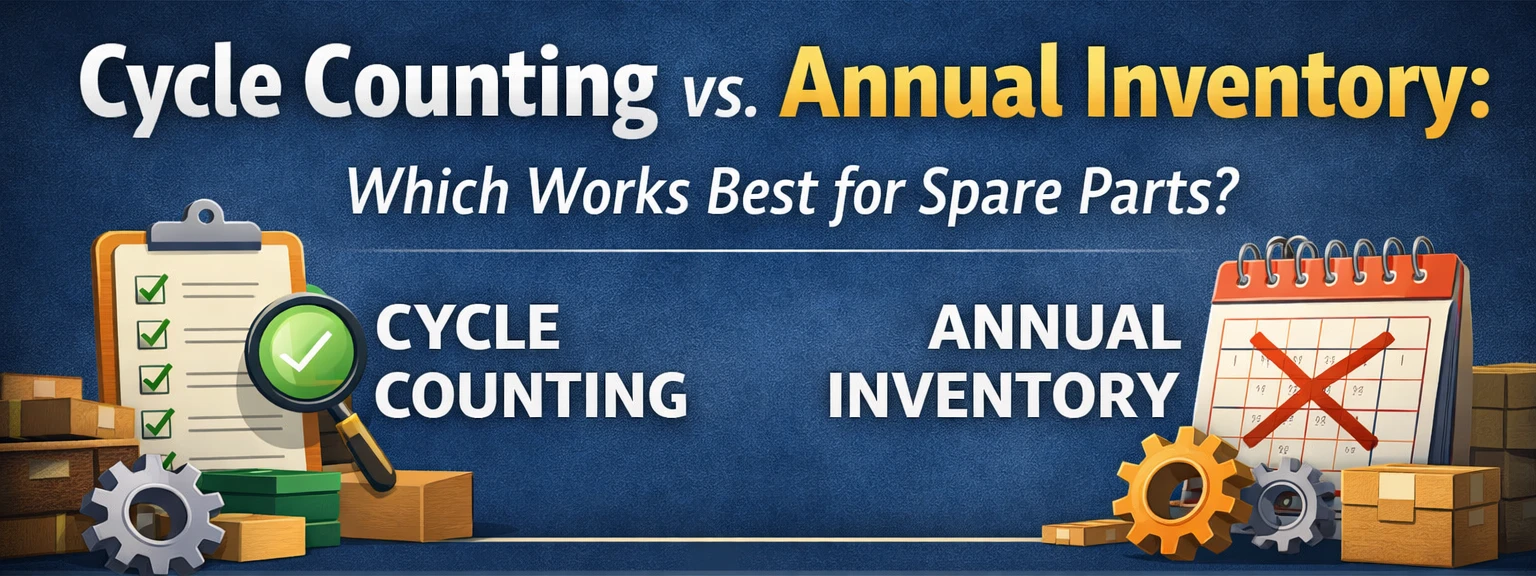
IntroductionInventory accuracy is critical for reliable spare parts procurement. But how should you track it? Many companies rely on annual inventory audits, while others use cycle counting for ongoing accuracy. Each method has strengths and weaknesses — especially in the world of industrial spare parts, where stock turnover and criticality vary widely.In this post, we compare both methods and explain how HUB’s tracking tools support smarter, more reliable inventory management.📅 What Is Annual Inventory?An annual inventory audit counts all stock items once per year — usually during a planned shutdown.✅ Pros:- Comprehensive "snapshot"- Useful for audits and compliance- Easy to schedule once annually❌ Cons:- Requires halting operations- Prone to large errors if stock drifts between counts- Time-consuming and resource-heavy🔄 What Is Cycle Counting?Cycle counting involves regularly counting small sections of inventory (e.g., weekly or monthly) rather than everything at once.✅ Pros:- Less disruption to operations- More consistent accuracy- Errors are caught and corrected faster❌ Cons:- Requires ongoing resources- May miss slow-moving items if not well-planned- Complexity increases with large inventories🧠 Which Works Best for Spare Parts?For high-value or fast-moving spare parts, cycle counting is typically superior because it ensures ongoing accuracy. However, annual inventory can be a good backup for full validation — especially for compliance or external audits.🚀 How HUB Enhances Both Methods ✅ 1. Automated Cycle Count Scheduling - HUB lets you schedule counts by part type, usage rate, or location — ensuring critical spares are checked more often. 📊 2. Real-Time Inventory Dashboards - Track discrepancies instantly with live dashboards that highlight mismatches between expected and actual stock. 🔔 3. Alerts for Slow-Moving or High-Risk Items - Prioritize cycle counts on items prone to errors, spoilage, or theft. 📤 4. Easy Data Export & Audit Reports - Generate reports instantly for external auditors or compliance checks.✅ ConclusionBoth cycle counting and annual inventory have roles to play — but for critical spare parts, ongoing cycle counts combined with HUB’s smart tracking tools give you the accuracy, flexibility, and confidence you need.🔗 Start Smart Counting with HUB: www.HUBspareparts.com🔗 Book a Demo of HUB’s Inventory Tools: WhatsApp Chat
IntroductionHaving too many spare parts might seem safe, but it’s a silent profit killer. Overstocking ties up capital, increases storage costs, and often leads to waste through obsolescence or damage. Many factories overcompensate to “be safe,” without realizing the hidden financial and operational costs.In this post, we unpack the real cost of overstocking and show how HUB’s smart inventory tools keep your spare parts levels optimized.💸 The Hidden Financial Costs of Overstocking - Capital Lock-In: Spare parts represent frozen cash that could be used elsewhere. - Higher Insurance & Taxes: Excess stock increases warehousing expenses and insurance premiums. - Depreciation & Obsolescence: Parts become outdated or unusable over time, especially in fast-evolving industries. - Waste from Damage or Expiry: Some items have shelf lives (e.g., lubricants, seals) and degrade when left unused.🏭 The Operational Downsides - Crowded Warehouses: Overstocking clutters space, making retrieval slower and harder. - Inventory Errors: Larger stockpiles lead to higher chances of miscounts, lost items, or duplicate orders. - Blocked Workflow: Unnecessary items consume resources like labor and storage that should focus on critical parts.🧠 How HUB Helps You Avoid Overstocking 📊 1. Data-Driven Demand Forecasting - HUB analyzes historical consumption trends to recommend optimal stock levels based on actual usage — not guesswork. 🛠️ 2. Dynamic Reorder Points - Rather than fixed formulas, HUB adjusts reorder points automatically as usage, lead times, or failure patterns evolve. 🚦 3. Slow-Moving Parts Alerts - HUB flags stagnant or slow-moving items, giving you a chance to repurpose, resell, or stop reordering. 📈 4. Real-Time Inventory Dashboards - Gain full visibility into stock levels by location, category, and criticality — ensuring you see and act on overstock trends. 🔄 5. Resale & Exchange System - Turn stagnant stock into cash or trade through HUB’s marketplace feature — freeing up capital and space.✅ ConclusionMore isn’t always better. Overstocking might feel safe, but it creates hidden costs that drain your budget and slow down your operations. With HUB, you can strike the perfect balance between availability and efficiency — keeping your inventory lean, optimized, and productive.🔗 [Try HUB’s Inventory Optimization Tools]🔗 [Book a Free Inventory Audit Demo]







You need to Sign in to view this feature

This address will be removed from this list
 english