



The Ultimate Guide to Setting Procurement KPIs for Maintenance Teams
Blog / Procurement Optimization
Procurement Optimization

The Ultimate Guide to Setting Procurement KPIs for Maintenance Teams

·
Mar 18, 2026
·
5 Views
2 Min read

Introduction

You can’t improve what you don’t measure. That’s why setting the right KPIs (Key Performance Indicators) is essential for optimizing spare parts procurement. For maintenance teams, KPIs are not just performance metrics — they’re the backbone of reliability, uptime, and cost control.

In this guide, we’ll walk you through the most important KPIs every maintenance team should track and how HUB’s industrial procurement ecosystem helps you measure and act on them.

📊 1. Order Lead Time
Definition: The time between placing an order and receiving the part.
Why it matters: Long lead times can delay maintenance or emergency repairs.
How HUB helps: HUB automatically tracks lead times by vendor and item, and notifies users when expected delivery windows are exceeded.

🔁 2. Stock Turnover Rate
Definition: How many times inventory is sold/used and replenished in a given period.
Formula:
Stock Turnover = Total Usage / Average Inventory
Why it matters: High turnover means better inventory efficiency. Low turnover can indicate overstocking or unused items.
How HUB helps: HUB calculates turnover trends and flags stagnant items that can be resold or reallocated.

⚠️ 3. Emergency Purchase Ratio
Definition: Percentage of purchases made outside the planned schedule due to urgent need.
Formula:
Emergency Purchase % = (Urgent Orders / Total Orders) × 100
Why it matters: High ratios show a reactive system and cost inefficiencies.
How HUB helps: HUB tracks urgent orders separately and helps shift toward predictive planning through usage analysis and automated reorder points.

🧾 4. Purchase Order Accuracy
Definition: The percentage of POs fulfilled without errors (correct item, quantity, spec).
Why it matters: Reduces rework, downtime, and trust issues with vendors.
How HUB helps: All POs go through digital approval workflows and vendor matching, reducing human error and improving accuracy.

📅 5. On-Time Delivery Rate
Definition: Percentage of parts delivered on or before promised date.
Why it matters: Reliable vendors = smoother maintenance scheduling.
How HUB helps: HUB tracks vendor performance and delivery history, helping you choose based on data, not guesswork.

💵 6. Procurement Cost per Order
Definition: Total cost incurred per procurement cycle (not just part price).
Why it matters: Includes labor, follow-ups, errors, freight — essential for real cost analysis.
How HUB helps: HUB generates cost reports factoring all inputs, including logistics, overhead, and time delays.

✅ Conclusion
Setting KPIs is only half the job — tracking and acting on them is what drives results. With HUB, maintenance teams can monitor key procurement metrics in real time, identify weaknesses, and continuously improve efficiency and uptime.

🔗 Start measuring KPIs with HUB : www.HUBspareparts.com
🔗 Book a free consultation for KPI setup: WhatsApp Chat
Share this article
Help others discover this story
Trending

Popular articles

See more
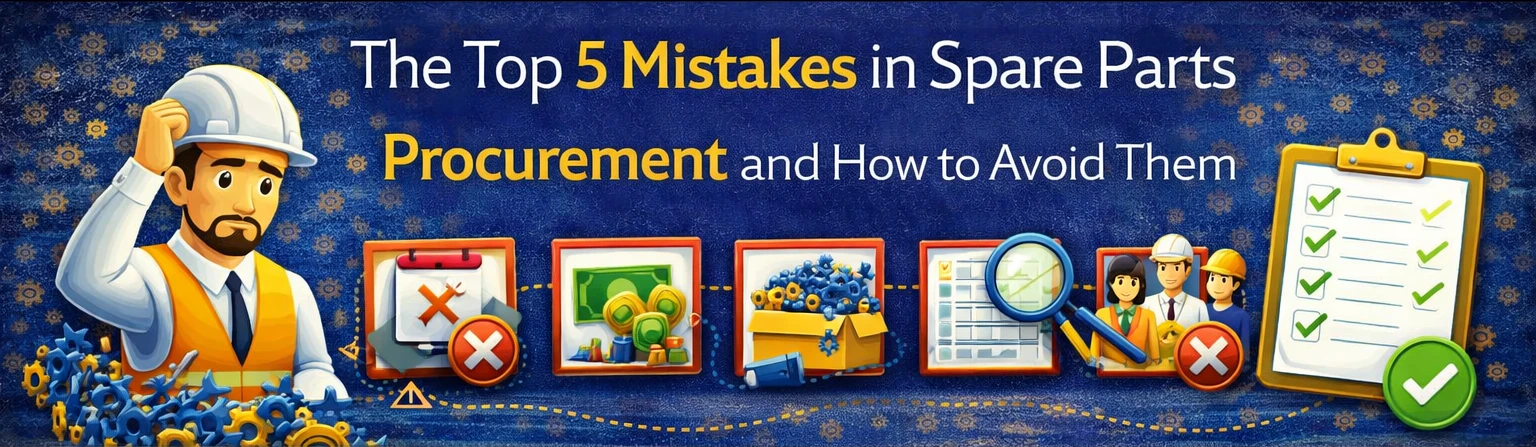
The Top 5 Mistakes in Spare Parts Procurement and How to Avoid Them

IntroductionIn the industrial world, spare parts procurement is often treated as a reactive process — leading to inflated costs, critical downtime, and misaligned inventory. Whether you’re managing a factory, overseeing a maintenance team, or handling purchasing, avoiding common procurement pitfalls is essential for operational efficiency.At HUB Industrial Spare Parts Procurement Ecosystem, we’ve worked with dozens of engineering teams and purchasing departments. We’ve identified the most frequent errors — and designed solutions that eliminate them.🛑 Mistake #1: Buying Only When Equipment FailsThe Problem:Waiting until something breaks before ordering the part leads to emergency costs, shipping delays, and avoidable downtime.The Solution:Use predictive procurement. HUB analyzes historical usage and machine life cycles to recommend when to buy critical spares — before failure happens.📦 Mistake #2: Overstocking Low-Moving Spare PartsThe Problem:Procurement teams often stock excessive quantities of “just-in-case” parts, tying up capital and storage space in dead inventory.The Solution:HUB provides consumption-based planning tools and even offers a resale/exchange marketplace where companies can offload stagnant inventory to others who need it.🧩 Mistake #3: No Standardized Approval WorkflowThe Problem:Without structured procurement workflows, decisions may bypass technical or budgetary checks — causing quality issues or misaligned purchases.The Solution:HUB enables a multi-tier approval process involving engineers, maintenance heads, procurement officers, and finance. This ensures right part, right reason, right budget.📉 Mistake #4: Not Comparing Vendors or PricesThe Problem:Many teams buy from the same vendors every time, missing out on better pricing, availability, or lead times.The Solution:HUB’s multi-vendor marketplace compares real-time pricing, delivery times, and product availability — across local and international brands — in one interface.🔍 Mistake #5: Lack of Procurement Data AnalysisThe Problem:Without data, it’s impossible to see what parts are overused, underused, or where procurement budgets are leaking.The Solution:HUB offers detailed data dashboards and AI-driven insights, helping you optimize reorder points, supplier selection, and yearly procurement plans.✅ Conclusion: Avoid Costly Mistakes with HUBAvoiding these common errors can save your facility significant time and money — and improve production reliability. HUB is built specifically to solve these problems, with features that predict demand, streamline workflows, and optimize inventory and vendor selection.🔗 Start using HUB now : www.HUBspareparts.com🔗 Book a free demo or strategy call : WhatsApp Chat

From Chaos to Control: Building a Structured Spare Parts Procurement Plan

IntroductionDoes your team still rely on WhatsApp messages, last-minute calls, or Excel sheets to manage spare parts purchases? If so, you’re not alone — but you’re also at risk of stockouts, overstocking, inflated costs, and production delays.It’s time to move from chaos to control with a structured spare parts procurement plan tailored for industrial operations.In this step-by-step guide, we’ll show you how to build a smart, streamlined procurement process — and how the HUB Industrial Procurement Ecosystem supports every step.🧭 Step 1: Audit Your Existing Spare Parts InventoryWhy it matters: You can’t manage what you can’t see.Action: List all spare parts in use, including frequency of use, lead times, current stock levels, and criticality.HUB Solution: HUB allows you to upload and track your inventory data for better visibility and forecasting.🛠️ Step 2: Categorize Spare Parts by Criticality & UsageWhy it matters: Not all parts are equal — a control relay and a PLC CPU don’t carry the same risk if unavailable.Action: Use ABC or VED (Vital–Essential–Desirable) analysis to rank parts.HUB Solution: HUB helps tag parts and assign levels to facilitate smarter reorder logic and budget planning.📅 Step 3: Create a Procurement ScheduleWhy it matters: Scheduling parts procurement around maintenance and consumption patterns prevents chaos.Action: Align purchases with planned downtime, seasonal demand, and lead times.HUB Solution: HUB’s scheduling feature allows you to automate procurement cycles and set alerts.📋 Step 4: Establish a Multi-Level Approval WorkflowWhy it matters: Without structure, engineers buy unapproved or overpriced parts.Action: Define roles: Engineers (request), Managers (review), Procurement (budget), Finance (approve).HUB Solution: HUB enables a tiered workflow for requests, reviews, and approvals — fully trackable.🧾 Step 5: Choose Verified Suppliers with Historical DataWhy it matters: Working with unreliable vendors leads to delays and quality issues.Action: Build a database of trusted vendors with historical performance indicators.HUB Solution: HUB hosts multi-vendor listings with ratings, price comparisons, and availability filters.📊 Step 6: Monitor, Analyze, and ImproveWhy it matters: The best plans are dynamic. Review what's working and adjust.Action: Use KPIs like lead time, stock turnover, emergency purchase ratio, and part consumption trends.HUB Solution: HUB provides AI-powered analytics dashboards to guide continuous improvement.✅ ConclusionA structured procurement plan is no longer a luxury — it’s a necessity for industrial performance. By organizing inventory, scheduling smarter purchases, involving the right people, and analyzing data, your spare parts strategy becomes a source of competitive advantage.HUB brings all of this together in one platform — from planning and approvals to supplier matching and analytics.🔗 Start planning with HUB : www.HUBSpareparts.com🔗 Schedule a free consultation: WhatsApp chat

Just-in-Time vs. Just-in-Case: Which Spare Parts Strategy Fits Your Plant?

IntroductionEvery maintenance manager faces a balancing act: order too many spare parts and risk tying up capital, or keep too few and risk a shutdown when something fails. These two extremes are embodied by two popular inventory philosophies: Just-in-Time (JIT) and Just-in-Case (JIC).So, which strategy is right for your plant — and how can you implement the right one intelligently?In this post, we’ll break down the pros and cons of each approach and explain how the HUB Industrial Procurement Ecosystem helps factories optimize their spare parts strategy through smart scheduling, analytics, and planning.🔁 What Is Just-in-Time (JIT) Procurement?JIT means keeping the bare minimum stock on hand and ordering parts exactly when needed — based on production schedules, equipment condition, or predictive analytics.✅ Benefits:      -  Lower inventory holding costs      -  Less warehouse space required      -  Reduced waste from obsolete parts❌ Risks:      -  Delays if suppliers are slow      -  High dependency on accurate forecasts      -  Supply chain disruptions can halt production📦 What Is Just-in-Case (JIC) Procurement?JIC means stocking parts “just in case” something fails. It's a buffer-heavy approach favored in unstable supply chains or high-risk environments.✅ Benefits:      -  Immediate availability of critical parts      -  Less downtime during emergencies      -  Greater flexibility❌ Risks:      -  Capital locked in unused inventory      -  Potential for obsolete stock buildup      -  Harder to manage for large SKUs🧠 How HUB Helps You Implement Smart JIT (or Hybrid) Strategies📊 1. Predictive Procurement with Data AnalyticsHUB uses your historical consumption, failure patterns, and machine data to forecast when specific parts will be needed — making JIT safer and smarter.📅 2. Spare Parts SchedulingSet automated reorder timelines based on planned maintenance windows and average usage cycles. HUB’s scheduling tool ensures parts arrive just before you need them — not after.📦 3. Critical Parts Classification & AlertsTag essential JIC components (like PLC CPUs or high-failure items) to remain stocked, while low-risk items are ordered JIT. HUB enables hybrid strategies — not one-size-fits-all.📈 4. Real-Time Inventory Visibility & Vendor IntegrationSee stock levels across departments and get real-time pricing and lead times from HUB’s vendor network — making JIT purchasing reliable.🔄 When to Use JIT vs. JIC (Decision Matrix)ScenarioRecommended StrategyLong supplier lead timesJust-in-Case (JIC)Stable supply chainsJust-in-Time (JIT)Budget or space constraintsJust-in-Time (JIT)Remote or critical operationsJust-in-Case (JIC)Data-rich, connected systemsJIT (with HUB)Limited analytics or visibilityJIC or hyprid✅ ConclusionBoth JIT and JIC have their place. The smartest strategy? Use data to guide when to apply each, and tools like HUB to execute your procurement strategy effectively.With HUB, your factory doesn’t have to choose between cost control and availability — you get both.🔗 Start optimizing your strategy with HUB : www.HUBspareparts.com🔗 Book a free consultation with HUB advisors : WhatsApp Chat